


Bass Recorders article
Bass Recorders for Beginners: A Complete Guide
Bass recorders are genuinely beginner-friendly woodwind instruments. This guide walks you through your first session, what to expect, and how to build a solid foundation for learning.
Bass Recorders for Beginners: A Complete Guide
If you've just discovered bass recorders and fancy learning one, you're in for a genuinely accessible and rewarding experience. Don't let the word "recorder" fool you—bass recorders are a real family of instruments with centuries of musical tradition, serious repertoire, and a thriving community of players. This guide is for someone picking one up for the first time, nervous about whether they can actually play it, and wanting to know exactly where to start.
The Good News About Starting Bass Recorders
First, the encouraging part: bass recorders are genuinely beginner-friendly. You'll produce a real, in-tune note within minutes of picking one up. Unlike learning an instrument where your first week produces squeaks and frustration, you're making music immediately. That matters. It keeps you motivated.
Bass recorders are also cheap to start with compared to most orchestral instruments. A decent beginner bass recorder costs £80 to £200, which is less than many alternatives. You can get a playable instrument for under £100 that will last you years.
The community is welcoming and genuinely supportive. Most bass recorder players remember struggling at the beginning and are happy to help newcomers. You'll find online forums, local recorder groups and college ensembles that actively recruit beginners.
Understanding What You're Getting Into First
Before you buy, know what you're committing to. A bass recorder is a woodwind instrument, about 60 cm long (two feet), played vertically like a regular recorder. It sits between the standard soprano recorder you might remember from school and the massive tenor recorder your teacher might have mentioned. The bass recorder sounds warm, woody and surprisingly deep—nothing like the high-pitched school instrument you learned as a child.
The notes sound lovely, but bass recorders require steady airflow and gentle articulation to sound their best. You need to think about support from your lungs, not wild air pressure. Beginners sometimes blow too hard and get a thin, whistly tone. Relaxed, consistent air—that's the secret.
Playing is physically comfortable. You hold it vertically, resting it gently in your hands. There's no tension required, no awkward reaching or straining. Most adult beginners find the physical experience intuitive after a few minutes.
Getting Your First Bass Recorder
Don't overthink this. Buy a beginner-level bass recorder from a respectable maker: Moeck, Aulos, Yamaha or Kung all make solid entry-level instruments. A decent bass recorder plays in tune, has a good tone and feels pleasant to hold. You don't need the professional model; spend what you can afford between £80 and £150.
If possible, buy from a music shop where you can hold it in your hand. Weight and grip matter. Some bass recorders are made from wood, others from plastic—both work, though wood sounds slightly warmer. As a beginner, plastic is fine. It's durable, doesn't need maintenance and sounds perfectly beautiful.
New bass recorders come with a fingering chart and basic instructions. That's all you need to start. You don't need accessories yet—just the instrument itself. You can add a stand or a soft case after you've worked out whether this is genuinely something you want to pursue.
Your First Session: What to Expect
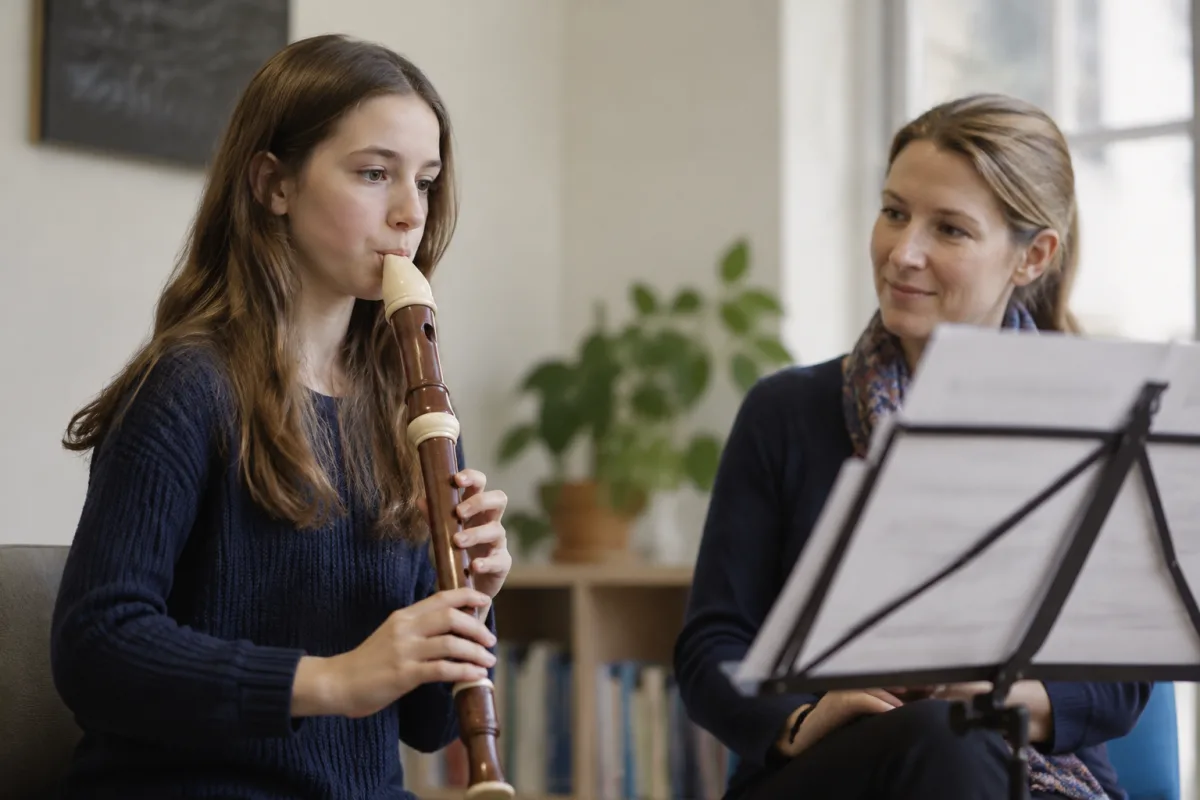
Hold the bass recorder vertically, with the thumbhole on the back. Cup your left hand at the bottom, your right above it. Relax your arms—don't lock your elbows or grip too tightly. This is not a battle; it's a gentle conversation with a piece of wood.
Blow gently through the mouthpiece, imagining you're fogging a mirror—steady, warm air, not forceful. Your lips seal loosely around the mouthpiece. You should hear a low, woody note immediately. If it sounds thin or whistly, ease back on the air pressure. If there's no sound, blow a bit harder. This calibration takes about five minutes.
Now place a finger over the first hole from the top on the front of the instrument. Blow steadily and cover the hole. The note will go up. Uncover it—the note drops. That's it. You've just played two notes with a bass recorder. You can carry a tune with these two notes. Many old folk songs exist in just two or three notes.
Spend your first session just playing single notes, finding the pressure that gives you a clear, steady tone. Don't worry about speed or learning whole pieces. Just enjoy making sounds. Some people get frustrated when they produce a squeaky note; this is normal. You're learning to coordinate your fingers with your airflow. It takes a few minutes to calibrate.
Avoiding the Common Beginner Mistakes
The biggest mistake is blowing too hard. The second biggest is holding the recorder too tightly. Both come from the same nervous impulse: the feeling that you need to grip and force the instrument into submission. You don't. Gentle is better. A lighter touch produces a warmer, more beautiful tone and actually makes the notes easier to hit accurately.
Another mistake is trying to run before you can walk. Some beginners download complicated sheet music expecting to play it immediately. Start with very simple things—single notes, two-note exercises, very basic folk songs. Your fingers need to learn the positions, and your air control needs practice. Trying to sight-read complex music when you're brand new is frustrating and counterproductive.
People sometimes jump to other fingerings or techniques after their first session, thinking they're missing something. You're not. Basic technique and consistent practice build everything else. If you can play a single note cleanly with a steady tone, you're not missing anything. You're literally where you should be.
Another common pitfall: assuming bass recorders are "just like soprano recorders, but lower." They're not. The fingerings are different, the air control is gentler, and the tone is totally distinct. If you learned soprano as a child, resist the urge to apply those habits directly. Start fresh. Your soprano muscle memory will confuse you at first; that's fine and temporary.
Building Your First Weeks of Practice
Week one is about discovering what the instrument does. Play with it for fifteen or twenty minutes, getting comfortable holding it, blowing steadily, and uncovering holes to make different pitches. Don't worry about anything except enjoying the process and hearing how it responds to your breath.
Week two, introduce the fingering chart that came with your recorder. It shows which holes to cover for each note. Practice finding C, D, E—these three notes. Slow down. Press your fingers down cleanly, covering the holes completely. Lift them clearly. If notes jump octaves or crack, it's usually because you're either covering holes partially or blowing too hard.
Week three, learn a simple tune. "Mary Had a Little Lamb," "Twinkle Twinkle Little Star," anything in three or four notes. Plodding slowly through something recognizable is far better than noodling randomly. Recognizable songs give you a sense of progress and purpose.
Throughout, practice for fifteen to twenty minutes most days. More than that is fine, but beginners shouldn't force themselves to practice more than feels fun. Consistency matters more than duration. Fifteen minutes daily beats an hour once a week every time.
Finding Teachers and Resources
A few lessons early on help enormously. A real teacher can show you how to hold the instrument, calibrate your air pressure and help you avoid bad habits. Four or five lessons in your first month—nothing intensive, just guidance—will accelerate your progress. Many recorder teachers offer beginner sessions specifically for adults.
Online resources abound. YouTube has beginner tutorials; some are excellent, others questionable. The American Recorder Society has resources and links to local groups. Many towns have recorder clubs or ensemble groups that welcome beginners and meet weekly.
Sheet music for beginners exists. Publishers like Schott and Moeck make beginner book series specifically for bass recorder. "Rhythmical Studies for Bass Recorder" by Paul Harris is an excellent standard text that thousands of beginners have worked through. It's affordable and genuinely well-designed.
When You're Ready to Progress
After a few months of steady playing, you'll know whether this matters to you. If it does, you can start exploring: more complex repertoire, joining a recorder ensemble, maybe investing in a better instrument. The journey from "nervous beginner" to "part of a community playing Bach" takes most people six to twelve months of regular practice.
Bass recorder music is genuinely beautiful. Baroque composers wrote specifically for recorders. Renaissance dance music comes alive on them. They're welcome in folk settings. Modern composers write for them. There's a real, living musical world waiting for you, and the entry price—both in money and learning time—is genuinely reasonable.
Your first weeks won't be perfect. You'll produce squeaky notes. You'll forget where your fingers go. You'll feel like you're not making progress sometimes. This is completely normal. Every bass recorder player you've ever heard started exactly where you are now. That nervous person picking up an unfamiliar instrument for the first time? That was everyone. Stick with it, enjoy the process, and trust that the smooth progress comes naturally once you get the basics under your fingers.
Getting Started: The Essential Checklist
- Buy a beginner-level bass recorder from Moeck, Aulos, Yamaha or Kung (£80–£150)
- Read the fingering chart that comes with it—you don't need anything else initially
- Practice fifteen to twenty minutes most days with simple, single-note exercises
- Learn to recognise the difference between "too hard" and "just right" air pressure
- After a week, learn three or four notes and a simple folk tune
- Consider four or five beginner lessons with a real teacher
- Join a local recorder ensemble or online community—the encouragement helps
- Keep enjoyment as your priority; if practice feels like work, ease back and rediscover play
The Sibling Resource
Once you've grasped the basics with this beginner guide, our complete guide to bass recorders covers the deeper technical aspects, history, and advanced topics.
Conclusion
Bass recorders are a genuinely welcoming instrument for adults learning music for the first time. The barrier to entry—both financial and technical—is low. You'll make music in your first session. The community is supportive, the repertoire is beautiful and deep, and the learning curve is manageable if you start simply and stay consistent. Pick one up, spend a few minutes learning the basics, and give yourself permission to be a beginner. You're exactly where you should be.


Comments