
Tape Players for Sale article
Tape Echo: A Complete Guide to Tape Delay Units
Every delay pedal has a setting called tape. Most are doing an impression of something that used to be a physical object with a motor in it — here is what they are imitating.
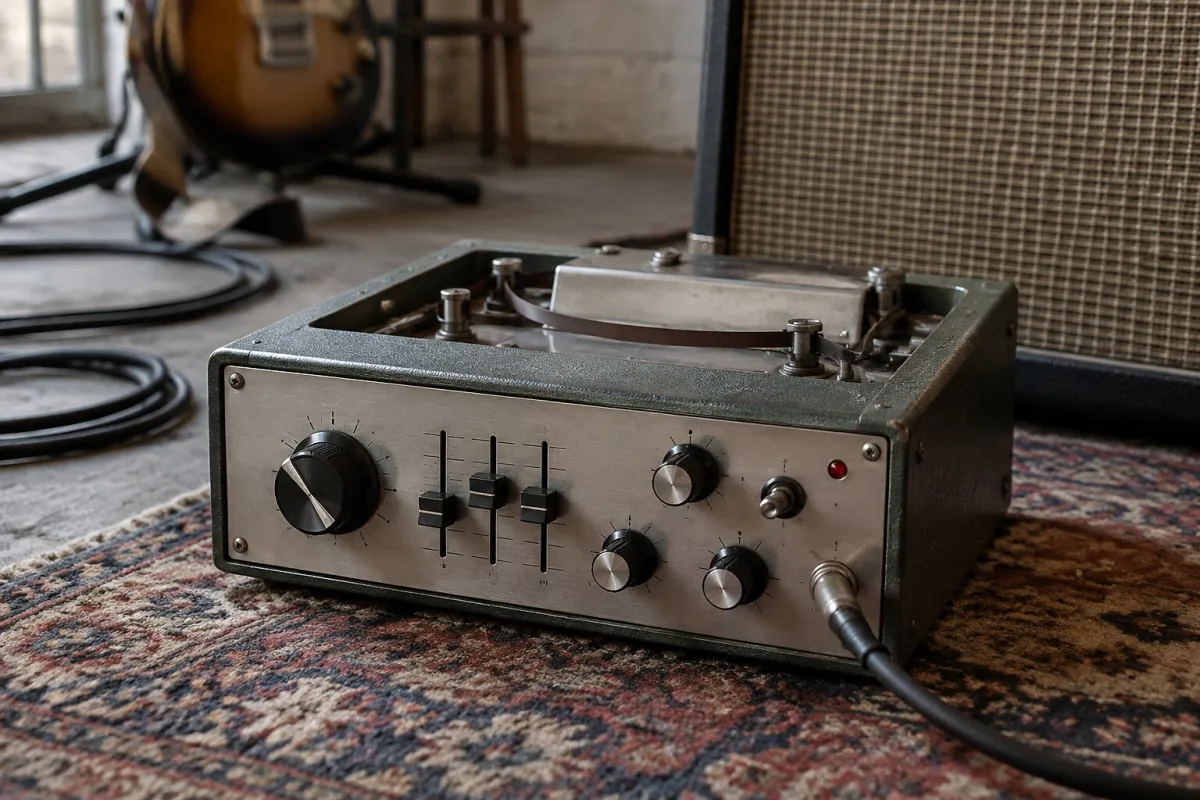
Every delay pedal on the wall has a setting called tape. Most of them are doing a decent impression of something that used to be a physical object with a motor in it, and if you have never used the real thing it is worth knowing what the impression is of.
Here is how tape echo works, why it sounds the way it does, and whether you actually want one.
What it is
A tape echo is exactly what the name says: a small tape recorder built to do one job. A loop of magnetic tape runs past a record head, which writes your signal onto it, and then past one or more playback heads, which read it back a moment later. That moment is your delay.
Change the speed of the motor and you change how long the tape takes to travel between the heads, which is how you set the delay time. Feed some of the output back to the input and the repeats repeat, which is your feedback control.
That is the whole mechanism. No clock, no processor, no algorithm — just tape moving past magnets at a speed you can alter.
Why it sounds different from a digital delay
A digital delay gives you back what you put in. A tape echo gives you back something slightly worse each time round, and that turns out to be the point.
- The repeats darken. Tape loses high frequencies, so each successive echo is duller than the last. Repeats sink politely behind the dry signal instead of cluttering it.
- Wow and flutter. Tiny variations in tape speed detune the repeats a fraction, which reads as warmth and movement.
- Saturation. Push the level and tape compresses and distorts gently rather than clipping hard.
- Self-oscillation. Wind the feedback past the point of sanity and the unit howls and builds. This is a documented technique rather than a fault.
The short version: a digital delay is accurate and a tape echo is flattering. Which you want depends entirely on the song.
The classics, briefly
The first portable machines of this kind were the American Maestro Echoplex and the English Watkins Copicat — self-contained tape machines built solely as echo units, and the reason a generation of British bands sounded the way they did.
The one most people mean, though, is the Roland RE-201 Space Echo, built from 1973 to 1988. It runs its tape loop past several playback heads, which you can combine for different rhythmic patterns, and it adds a spring reverb alongside the echo plus bass and treble controls that shape the repeats.
Its cleverest feature is the least glamorous. Rather than reels or a cartridge, the RE-201 uses a free-running transport, which reduces tape wear, noise, and wow and flutter, and lets you use whatever tape you like. That made it far more roadworthy than its rivals — the Echoplex and the Binson Echorec are wonderful machines with a deserved reputation for choosing the worst possible moment to misbehave.
Living with a real one
This is the part the demo videos skip.
- Tape is a consumable. It wears, and a tired loop sounds dull and unstable. Budget for replacement loops as a running cost.
- Heads need cleaning. Oxide builds up and the sound degrades gradually enough that you may not notice until you clean them.
- It has moving parts. Motors, belts and capstans age. A forty-year-old unit is a vintage machine and should be priced as one.
- It is heavy and it hates being dropped. A pedalboard-friendly object it is not.
- It is noisy. There is a noise floor. On a record that is character; through a quiet PA it is a decision.
So do you want one?
Be honest about which part you want. If it is the sound — the darkening repeats, the drift, the saturation — then a good modern emulation, pedal or plugin, will get you most of the way for a fraction of the money and none of the maintenance. That is not a compromise position; it is what most working players now use.
If it is the behaviour — the way a real tape echo responds when you ride the controls, the unpredictability, the way it fights back when you push it into oscillation — then only the real thing will do, and you will need to accept that you have bought a machine that requires looking after.
Buying a vintage unit
Power it up before money changes hands, and listen for steady speed rather than a wavering pitch. Check the feedback control sweeps smoothly into oscillation without crackling. Ask when the tape was last changed and when the heads were last cleaned, and check whether the motor sounds laboured. Finally, find out who services these locally before you buy, not after — that answer decides whether a tape echo is a joy or an ornament.
Buy well and it will outlive every digital pedal you own. That has been true for fifty years already.



Comments