
Pedalboard with Pedals article
The Complete Guide to Pedalboard With Pedals
A pedalboard with pedals is the guitarist's command centre — a carefully arranged collection of effects that transform your sound in real time.
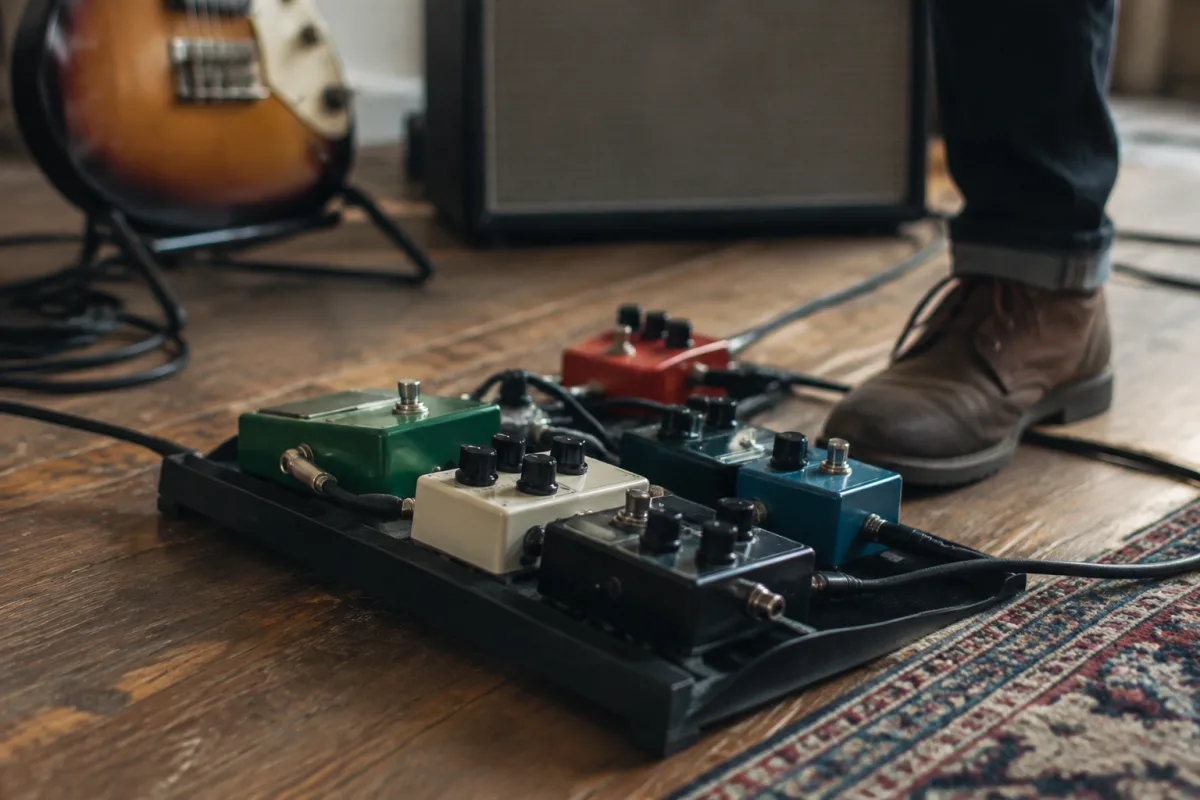
A pedalboard with pedals is the guitarist's command centre — a carefully arranged collection of effects units that shape, colour and define your sound. Whether you're a bedroom hobbyist or a touring professional, setting up the right pedalboard with pedals transforms how you play, what you hear and how easily you can switch sounds mid-performance.
What Is a Pedalboard With Pedals?
A pedalboard with pedals is simply a pedalboard — a flat, portable platform — loaded with guitar effects pedals and the cables, power supply and accessories needed to run them. The pedalboard itself is usually a sturdy wooden or composite board with a non-slip top surface. Mounted on it are your individual pedals: distortion, delay, reverb, compressor, tuner, wah-wah and countless others. Think of the pedalboard with pedals as an integrated rig — the board plus the effects ecosystem running on it.
The power of a pedalboard with pedals lies in its flexibility. You're not stuck with a digital multi-effects unit's preset templates; instead, each pedal does one thing exceptionally well. You then chain them together in whatever order makes sense for your music and your ears.
Why Build a Pedalboard With Pedals?
A custom pedalboard with pedals gives you sound independence. You choose exactly which effects you need, experiment with different signal chain orders and upgrade individual pedals over time without replacing the whole system. That creative control and modularity are why touring musicians and serious hobbyists invest in a pedalboard with pedals.
Analogue pedals also tend to sound warm and natural compared to digital units, and the tactile, immediate feedback of stomping a pedal on and off is hard to beat in a live setting. A well-built pedalboard with pedals is a joy to use.
Building Your Pedalboard With Pedals: The Essentials
Every functional pedalboard with pedals needs a few core elements:
- The board itself — sized to your needs (small travel boards hold 4–6 pedals; larger boards fit 15+). Look for solid construction and good weight distribution.
- A tuner pedal — placed first in the signal chain, so you can mute the output while tuning.
- A power supply — preferably isolated, so ground noise from one pedal doesn't bleed into others. Crucial for a clean pedalboard with pedals.
- Patch cables — short, high-quality cables that connect pedal to pedal without introducing noise.
- A gig bag or flight case — to protect your pedalboard with pedals during transport.
Signal Chain Order (The Golden Rules)
The order of effects on your pedalboard with pedals matters enormously. Here's the classic order most guitarists follow:
- Tuner — catches the dry signal first.
- Compressor — evening out dynamics before they hit other effects.
- Overdrive/Distortion — the drive or "dirt" section.
- Modulation (chorus, phaser, flanger) — effects that modulate the tone.
- Delay — time-based effects.
- Reverb — usually last, adding space and ambience.
That said, every pedalboard with pedals is individual. Putting reverb before delay gives a different, dreamier character. Stacking overdrives creates thick, singing sustain. Experimentation is half the fun. The classic order is a starting point, not a law.
Noise Management on Your Pedalboard With Pedals
A noisy pedalboard with pedals is a frustration. Keep hum and buzz down by:
- Using an isolated power supply (far more effective than daisy-chaining adapter cables).
- Keeping patch cables short and separated from power cables where possible.
- Grounding the board to your amp (sometimes a ground loop hum disappears when the board's jack is connected to the amp input).
- Checking cable quality — fraying or damaged patch cables introduce noise fast.
- Using buffers if you're running a very long pedalboard with pedals or many analogue pedals in series.
Common Pedalboard With Pedals Layouts
Different playing styles call for different pedalboard with pedals setups. A blues guitarist might build around a tuner, compressor, one overdrive and reverb — lean and mean. A shoegaze musician might layer six delays, reverbs and modulation effects for lush texture. A metal player might cram in multiple distortions, a noise gate and boost. A jazz guitarist might add a compressor, chorus and reverb for articulation and space. All are valid pedalboards with pedals.
Maintenance and Upkeep
Your pedalboard with pedals will last longer if you look after it:
- Keep cables tidy — a rat's nest of cables degrades signal quality and makes troubleshooting a nightmare.
- Protect connectors and inputs from dirt and moisture, especially if you play outdoors.
- Check power supply voltage now and then; a weak supply can cause subtle noise.
- Replace batteries in wireless systems or backup amp-mounted tuners on schedule.
- Consider a soft case or cover to protect your pedalboard with pedals from dust and impacts between gigs.
Upgrading Your Pedalboard With Pedals
The joy of owning a pedalboard with pedals is that you can evolve it. Start small, add pedals as your taste and budget allow, swap out effects that don't serve your music and keep what works. Many players find themselves tweaking their pedalboard with pedals every few months — a new drive here, a reverb there — as their ear develops and their needs change.
A pedalboard with pedals is a living thing, shaped by your playing and your creativity. Unlike a fixed multi-effects unit, it grows with you.
Conclusion
A well-chosen pedalboard with pedals is one of the most satisfying investments a guitarist can make. It puts your sonic identity in your hands, lets you respond creatively in real time and builds a rig that truly reflects how you play. Whether your pedalboard with pedals is compact or sprawling, humble or high-end, the magic is the same: total sonic freedom and the raw pleasure of stomping a foot to transform your tone instantly.



Comments