
Marshall Class Five article
The Complete Guide to Marshall Class Five
The Marshall Class Five delivers authentic tube breakup and Marshall character at five watts, making it ideal for players seeking genuine tone at household volume levels.
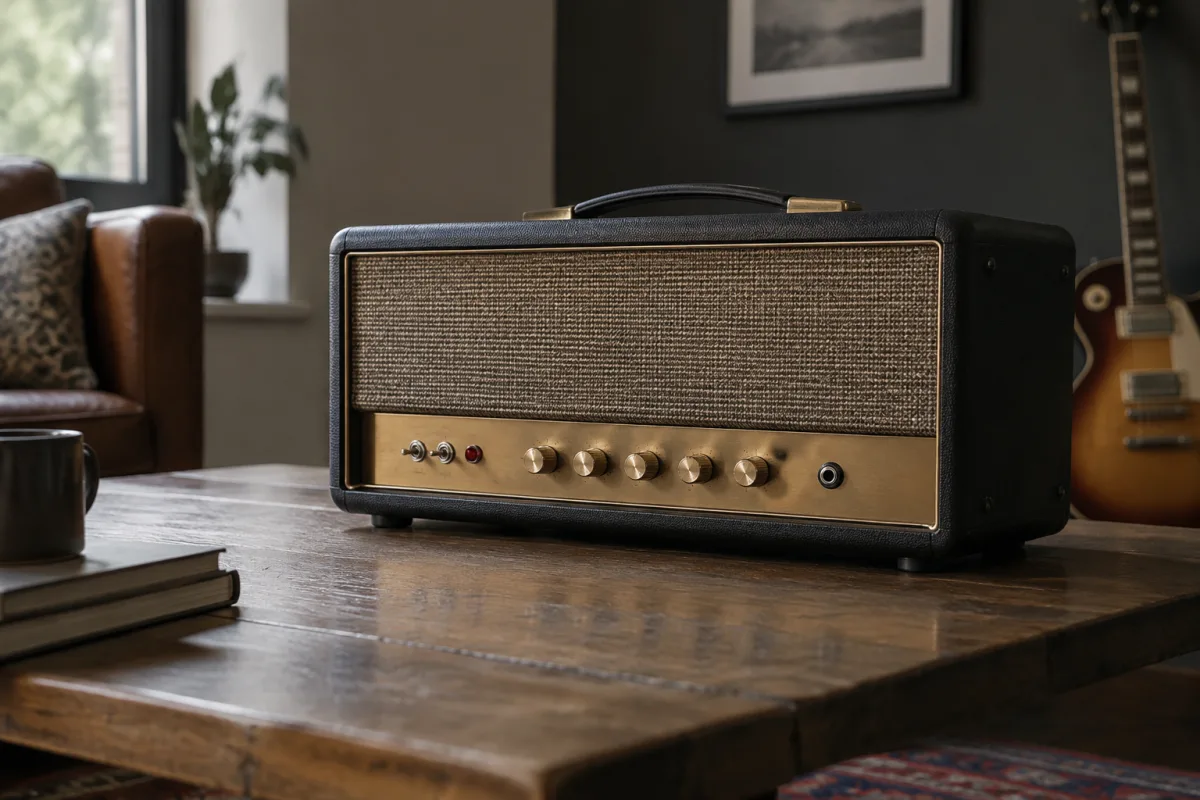
The Marshall Class Five is a compact tube amplifier that bridges the gap between bedroom practice and stage-ready performance. With five watts of output, it delivers the warm breakup and harmonic complexity of tube saturation at bedroom volumes, yet enough power to cut through a band mix or hold its own in a small venue. For guitarists seeking authentic tube tone without the heat, weight, or expense of larger Marshall stacks, the Class Five offers a compelling proposition.
Design Philosophy and Heritage
Marshall's Class Five represents a modern interpretation of vintage combo amp design. The company's core philosophy — that tube saturation and natural breakup define great guitar tone — remains central. Rather than creating a scaled-down imitation, the Class Five is engineered to be a complete, functional amplifier in miniature: genuine 12AX7 and EL84 tubes, a three-band EQ, and a speaker that captures Marshall's characteristic tone in a chassis you can transport in one hand.
The five-watt rating is key: loud enough to gig, quiet enough to explore tone without disturbing neighbours or drowning band members. It's the wattage sweet spot for bedroom-to-stage versatility.
Tube Configuration and Tone
The Class Five uses a pair of 12AX7 preamp tubes for gain and saturation, and two EL84 power tubes for that characteristic Marshall bite. This configuration is derived from Marshall's legendary 1959 Plexi design, one of the most emulated amplifiers in rock history. The tonal DNA is there: thick, aggressive breakup when pushed, musical distortion that responds to picking dynamics and playing intensity.
At five watts through a single eight-inch speaker, the Class Five doesn't produce the low-end thunder of larger Marshall stacks, but it captures the midrange punch and treble edge that defines Marshall character. Plugged into a decent cabinet or mic'd up for recording, it rivals larger amps in recorded tone.
Input Stage and Drive Control
The amplifier has a single input and a three-position input pad switch that lets you match input level to different instruments and effect levels. This is crucial for tone shaping at low volumes: a hot signal from active pickups or effect pedals benefits from the pad switch to prevent excessive preamp saturation; a passive guitar might need no pad.
The volume control is logarithmic (non-linear), meaning most useful tonal range occurs in the first third of travel. This lets you achieve creamy breakup at conversational volume levels — a critical feature for bedroom playing where you can't actually turn the amp up loud without problems.
Tone Controls and Flexibility
The three-band EQ (bass, mid, treble) is standard Marshall fare. These knobs have real effect; the tone circuit is interactive rather than isolated, meaning EQ settings influence how the tubes respond. Turning up the bass adds weight and increases breakup; rolling off treble tames brightness without sounding dull.
A presence control (a high-frequency boost behind the master volume) adds sizzle and cut when you need to punch through a mix. This is a professional feature usually found on larger amps, included here to make the Class Five genuinely competitive in band situations.
Power Output and Headroom
Five watts is the actual power amp output. There's no headroom in the traditional sense; the Class Five is designed to breakup quickly and sonically, making saturation part of the tone rather than something to avoid. For guitarists accustomed to digital modelling or solid-state amps that can be driven hard while staying "clean," the Class Five's natural breakup is something to embrace rather than circumvent.
The tradeoff: if you want pristine, undistorted tone, you have to keep volume very low or use the pad switch to tame input level. Most players find that musical distortion is the point.
Speaker and Cabinet Options
The standard Class Five includes a single eight-inch Marshall speaker — efficient, portable, and adequate for practice and small gigs. The speaker is removable; some players upgrade to higher-quality aftermarket options or mic it up for recording and stage use.
Marshall offers optional speaker cabinets: a single 12-inch extension cabinet adds depth and volume projection without requiring a larger main amp. Pairing the Class Five with an external cabinet changes the sonic character; eight-inch speakers are punchy and articulate; 12-inch speakers add warmth and low-end extension.
Practical Applications
The Class Five excels for several use cases. Bedroom and studio practice is obvious: you get tube tone at manageable volume. Small venue gigging is practical: five watts is enough to cut through a mix if mic'd through the PA, or played direct into an extension cabinet. Session recording benefits from the compact size and manageable noise floor. Some players use the Class Five as a bedroom tone reference, comparing effect chains and amp settings without requiring full volume.
Less practical: outdoor festivals, large venues, or situations where serious volume is non-negotiable. For those contexts, step up to a larger Marshall or pair the Class Five with a larger cabinet and external power amp.
Portability and Practicality
Weighing roughly 13 pounds (including the eight-inch speaker cabinet), the Class Five is genuinely portable — you can carry it on public transport, fit it in a car boot alongside band gear, or travel with it. The compact size also means minimal footprint in apartments or shared spaces where space is tight.
That said, tube amps require warm-up time (a few minutes before they sound their best) and the eight-inch speaker has acoustic limitations. For live use, mic amplification or an extension cabinet is often necessary to reach adequate stage volume.
Maintenance and Reliability
Tube amps are more demanding than solid-state instruments. The Class Five, being tube-based, generates significant heat; adequate ventilation prevents component damage. Tubes have a lifespan (power tubes typically last five to ten years depending on use intensity); replacement tubes cost £15–50 each, a modest maintenance expense.
Power tubes require occasional biasing — an adjustment that ensures optimal tube life and tone. Some players bias their own amps; others take them to qualified technicians. This maintenance is part of tube amp ownership; if you're not comfortable with it, budget for occasional servicing.
Cost and Value Proposition
The Marshall Class Five retails around £600–700, a significant investment for a five-watt amp. Compared to high-end combo amps (£1,500+) or entry-level solid-state practice amps (£100–300), it occupies a middle ground: more expensive than budget options but far less expensive than professional rigs.
The value lies in authentic Marshall tone at bedroom volume, genuine tube dynamics, and portability. If tube tone at low volume is your goal, it's priced competitively. If you need maximum volume or maximum feature set, better value exists elsewhere.
Conclusion
The Marshall Class Five is an elegant solution to a real problem: how to achieve genuine tube tone and breakup without the volume, weight, and cost of traditional Marshall stacks. For bedroom players, small-venue musicians, and anyone seeking Marshall character in a compact package, it delivers convincingly. The eight-watt speaker has acoustic limitations and outdoor gigging requires support infrastructure, but for its intended purpose — tube tone at household volume — the Class Five succeeds admirably.


Comments