


Effects Pedals Power Supply article
Everything You Need to Know About Guitar Effect Pedal Power Supply
A quality power supply transforms your effects setup from temperamental to bulletproof. This guide explains what to look for, how to size correctly, and why isolation matters.
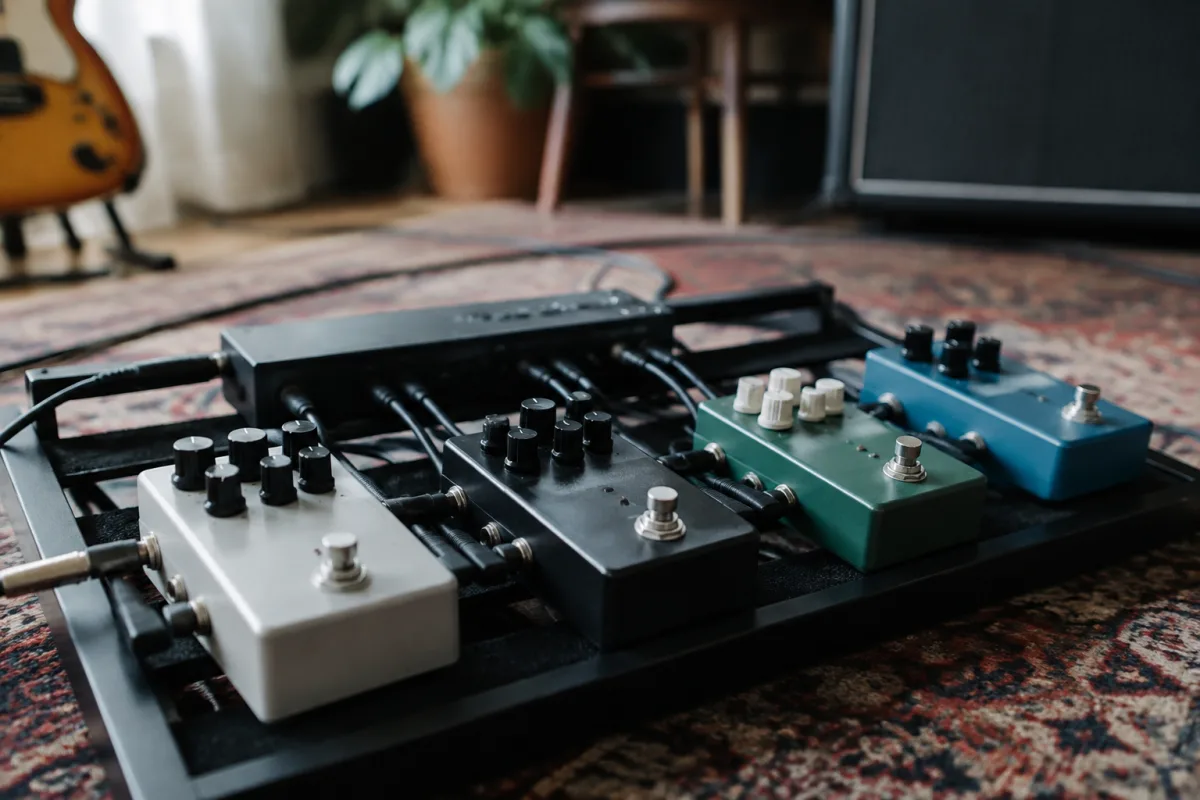
Every guitarist who uses effects pedals faces the same challenge: powering them reliably without creating a tangled nightmare of batteries and wall adapters. The right power supply makes all the difference, transforming your rig from temperamental to dependable. This guide covers everything you need to know to choose and use one effectively.
What Does an Effects Pedals Power Supply Do?
A power supply converts AC mains electricity into the clean DC power that modern guitar pedals require. Unlike batteries, which gradually lose voltage and die mid-gig, a dedicated unit delivers consistent, stable power to every pedal in your setup, eliminating voltage sag and the hum that can plague battery-powered rigs.
Most pedals draw between 50 milliamps and 500 milliamps of current, depending on their circuitry. A quality supply provides multiple isolated outputs, meaning each pedal gets its own "clean" power rail, preventing noise and interference that might occur if all pedals shared a single source.
Types of Effects Pedals Power Supply
Effects pedals power supplies fall into several distinct categories, each suited to different performance scenarios:
- Compact supplies — Designed to fit underneath or beside a small pedalboard, these offer 2–4 isolated outputs, typically delivering 500 mA to 1 A total. Perfect for bedroom players or minimal live setups.
- Mid-size options — Offering 4–8 isolated outputs with 1.5–2 A total current, these balance power and portability. Ideal for touring musicians and serious hobbyists.
- Large isolated units — Professional-grade supplies with 8–10+ isolated outputs, delivering 2–4 A total. Designed for complex rigs with many high-current pedals or redundant systems.
- Daisy-chain supplies — Budget options with one power input splitting into multiple connectors. These do not isolate grounds between pedals, leading to noise — avoid them unless you have only one or two pedals drawing minimal current.
Key Specifications to Understand
When evaluating your options, check these critical specs:
Voltage output: Most guitar pedals run on 9V, though some boutique designs use 12V, 18V, or even 24V. Check your pedal manual. A dual-voltage supply can handle both 9V and 12V pedals simultaneously.
Current per output: Measured in milliamps (mA), this tells you the maximum power each isolated outlet can safely deliver. A typical compact unit might offer 400 mA per output; larger supplies go to 1000 mA or beyond. Never exceed the rated current — it will trigger the protection circuit and shut down that output.
Total current available: This is the sum of all outputs running simultaneously. If your pedalboard draws 300 mA, 200 mA, and 250 mA across three pedals, you need a supply with at least 750 mA total capacity, plus a safety margin.
Isolation: True isolated outputs prevent ground loops and hum. All professional-grade units use isolation; budget daisy-chain options do not.
Compatibility with Common Pedal Types
| Pedal Type | Typical Current Draw | Voltage | Notes |
|---|---|---|---|
| Overdrive/distortion | 20–100 mA | 9V | Very light load; battery-friendly |
| Digital delay/reverb | 150–400 mA | 9V | Moderate power; needs isolation |
| Looper | 200–600 mA | 9V or 12V | Heavier load; check supply specs |
| Expression pedal | 50–150 mA | 9V | Light load; often powered by the delay/reverb |
| Modulation (chorus, phaser) | 80–250 mA | 9V | Moderate; benefits from isolation |
How to Size Your Supply Correctly
Sizing is straightforward: total the current draw of every pedal you plan to use simultaneously, then choose a unit with at least 20 per cent headroom above that figure.
If you own a compact pedalboard with an overdrive (60 mA), a digital delay (300 mA), and a modulation pedal (150 mA), your peak draw is 510 mA. A 1-amp supply gives you comfortable headroom.
If you're unsure of a pedal's current draw, check the manufacturer's data sheet or contact them directly. Never guess — undersizing risks shutdowns mid-performance, whilst oversizing simply costs more without added benefit.
Isolation, Ground Loops and Hum: Why It Matters
A poorly chosen supply can introduce a low-frequency hum into your signal chain, usually 50 Hz (mains frequency in the UK) or harmonics thereof. This stems from ground loops — multiple paths for electrical current that create standing waves on your signal lines.
A truly isolated power solution breaks these loops by giving each pedal its own return path to ground, eliminating the hum. This is why professional units cost more: isolation transformers or multiple voltage regulators are expensive, but they solve the problem completely. Budget daisy-chain supplies fail here because all pedals share the same ground return, enabling hum.
Installation Best Practices
Once you've chosen the right unit, install it correctly:
- Position the supply where it will not overheat — avoid taping it under the pedalboard directly against your case.
- Use the correct connector type for your pedals. Most modern pedals use a 2.1 mm centre-negative jack; older Boss/Roland pedals use centre-positive. Mismatched connectors can destroy a pedal instantly.
- Run power cables away from audio cables to minimise crosstalk.
- Leave at least 10 per cent headroom on total current; the supply will run cooler and last longer.
- If using multiple isolated outputs, keep the power cable runs short and use quality shielded connectors.
Popular Effects Pedals Power Supply Options
The market offers solutions at every price point. Entry-level compact supplies (under £50) provide basic isolation and 4–6 outputs, suitable for small boards. Mid-range options (£50–150) offer better build quality, more outputs, and higher total current. Professional supplies (£150 and up) add redundancy, switching capabilities, and bulletproof reliability for touring musicians.
When choosing, prioritise isolation and total current capacity over brand name. A no-name isolated supply from a reputable online retailer will outperform a famous-brand daisy-chain supply every time.
Troubleshooting Common Power Supply Problems
If a pedal cuts out unexpectedly, the supply has likely hit its current limit on that output. Move the pedal to a different isolated output or upgrade to a higher-capacity supply. If you hear hum, check that your supply truly isolates grounds and that you're using the correct connector polarity. Test by plugging one pedal directly into the supply with its dedicated cable — if the hum vanishes, the issue is cable crosstalk or daisy-chaining, not the supply itself.
Conclusion
A quality effects pedals power supply is one of the best investments a guitarist can make. It eliminates battery changes mid-gig, removes ground hum, and gives you the headroom to expand your pedalboard without worry. Choose an isolated supply with sufficient current capacity, install it correctly, and your effects will stay powered and quiet through every performance.





Comments