
Boss Effect Pedal article
The Complete Guide to Boss Effect Pedal
Boss effect pedals are trusted by touring musicians worldwide. Learn about essential models, how they integrate and why they're the industry standard.
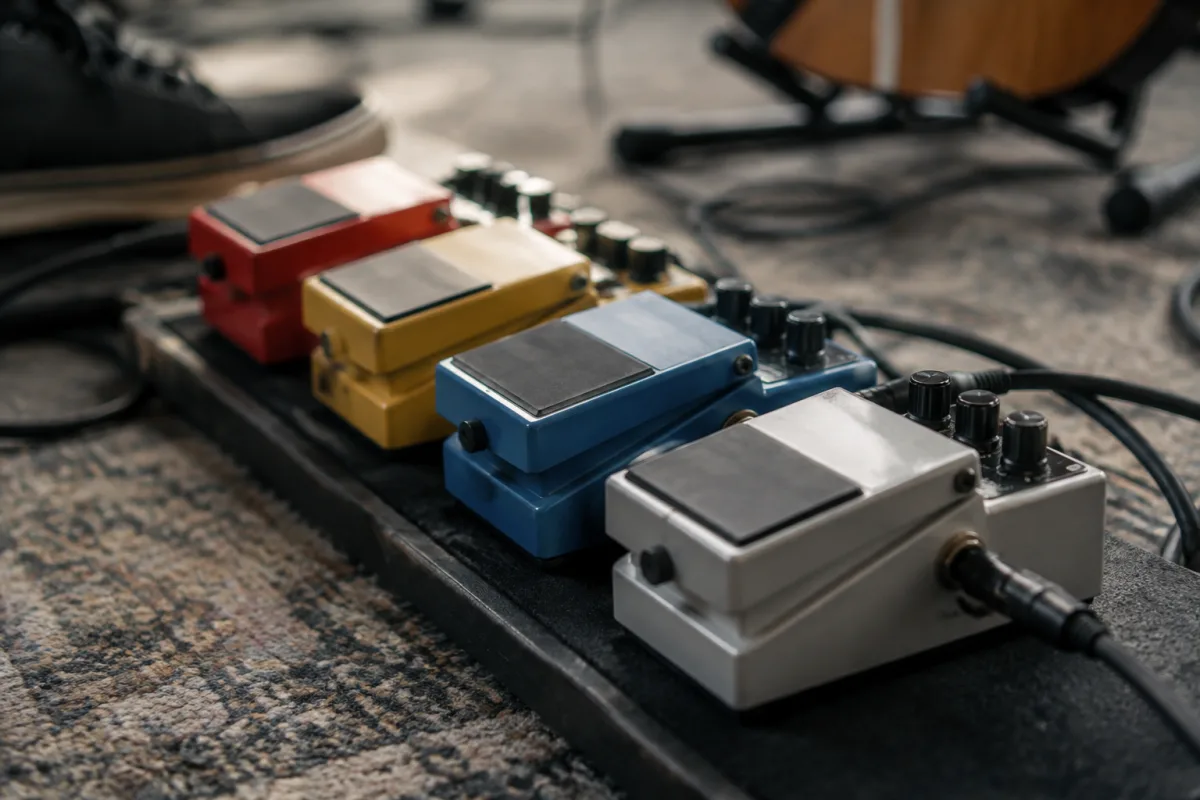
Boss Effect Pedals: Industry Standard for Musicians
Boss, a division of Roland Corporation, dominates the guitar effects pedal market worldwide. For over 40 years, Boss effect pedals have been the standard choice for professionals, touring musicians and serious hobbyists. Quality, reliability and ubiquity make Boss pedals a safe choice and often an essential item on any working musician's pedalboard.
Why Boss Dominates the Pedal Market
Boss effect pedals are built to withstand touring abuse. The metal chassis, rubber corners and sealed circuitry mean a Boss pedal will outlast its owner's playing career. Reliability is legendary; stories abound of 30-year-old Boss DS-1 distortions and Boss DD-5 delays working perfectly after decades of gigs. This reputation, combined with affordable pricing and availability worldwide, makes Boss the default choice for working musicians.
Additionally, Boss's integration with larger ecosystems (multi-effects units, expression pedals, switching systems) and their continuous product evolution keep them relevant. A guitarist who buys a Boss pedal today can be confident it will remain useful and valuable for years to come.
Boss Single-Function Pedals
Distortion and Overdrive
The Boss DS-1 distortion and Boss OD-1 overdrive are rock staples. The DS-1 (£60–90) is aggressive and widely cloned; the OD-1 (£80–120) is warm and mid-friendly. Modern alternatives include the Boss Heavy Metal (HM-2) for metal, the Boss Blues Driver for blues tone, and the Boss Distortion Pedal DS-2 with dual mode switching.
Delay
The Boss DD-5 (now DD-7 or DD-8) is the industry standard delay. Three or four selectable algorithms (digital, analogue, reverse, tape), tap tempo, and reliable operation make it essential on tour. Cost: £150–180. Tape simulation is particularly prized for warm, natural tone.
Reverb
The Boss RV-5 (£120–150) offers spring, plate, hall and room algorithms in a compact pedal. Solid build, intuitive controls and enough character to suit rock, blues and pop. The RV-6 adds more algorithms and modulation.
Chorus, Flanger and Phaser
The Boss CE-5 chorus (£80–120) is ubiquitous for warm, dimensional tones in rock, pop and alternative. The CH-1 is compact, portable and affordable. Flangers (BF-2, BF-3) and phasers (PH-1, PH-2) offer vintage and modern character.
Compression
The Boss CS-3 compression pedal (£70–100) is a workhorse for sustain, dynamic control and tone shaping. Simple three-control interface (sustain, attack, tone) makes it immediately useful; many players leave it on full time for tone glue.
Boss Multi-Effects Units
Boss's multi-effects platforms (GT-1, ME-80, ME-50) combine hundreds of effects in one compact unit. Entry-level (£150–300) gives basic effects; mid-range (£400–700) offers professional-grade sound and expression control; high-end (£1000+) rivals rack-mount systems in depth. Multi-effects are ideal for bedroom recording, songwriting and minimalist pedalboards.
Boss Compact Pedals vs Full-Size
| Factor | Compact Pedals | Full-Size Pedals |
|---|---|---|
| Size | 2.5" x 2.5" — fits in a bag, minimal pedalboard space | 5" x 3" — requires dedicated pedalboard real estate |
| Cost | £40–80 — budget-friendly option | £80–150 — higher investment |
| Features | Single footswitch, minimal knobs — simple | Multiple footswitches, expression pedal — more control |
| Durability | Same robust metal chassis; proven reliable | Identical build quality; larger footprint distributes stress |
| Sound | Identical to full-size equivalent; no compromise | Identical algorithms and tone; slightly more control |
Boss Pedal Setup and Integration
Boss pedals integrate seamlessly with Boss multi-effects and controllers via MIDI. Expression pedals (EV-5, EV-7) add real-time control over effect parameters. Pedalboard power supplies (PSA, BCB, FB series) provide stable power to multiple pedals simultaneously. This ecosystem approach allows infinite expandability without compromising tone or reliability.
Common Boss Pedal Models and Uses
- DS-1 — legendary distortion; sounds like classic rock and metal staple
- DD-7/DD-8 — industry-standard delay; tape simulation, tap tempo, three modes
- RV-5/RV-6 — solid reverb; room, hall, plate and spring algorithms
- CE-5/CH-1 — essential chorus for warmth and dimension
- CS-3 — trusty compressor; sustain, attack and tone control
- ME-80 — premium multi-effects; pedalboard and amp modeller in one
Buying Boss Pedals: New vs Used
New Boss pedals come with warranty and current algorithms. Used Boss pedals are excellent value: a 10-year-old Boss DS-1 (£30–50 used) sounds identical to new. Vintage Boss pedals (1980s–1990s) often become collector's items and hold or appreciate in value. Buy from reputable shops or online marketplaces; all-metal construction means physical damage is obvious, and electronics rarely fail.
Verdict
Boss effect pedals are the trusted choice for working musicians worldwide. Whether you build a pedalboard of individual pedals or invest in a multi-effects unit, Boss offers quality, reliability and sonic character suited to rock, blues, metal, pop and alternative music. A single Boss pedal, properly maintained, can outlast decades of playing. For any musician serious about their tone, a Boss pedal is a sensible investment and an industry-standard building block.


Comments