


Boost Pedal Buying guide
Boost Pedal: A Complete Buyer's Guide
Complete guide to choosing a boost pedal. Learn about boost types, key specifications, signal chain placement, and recommendations for every budget.
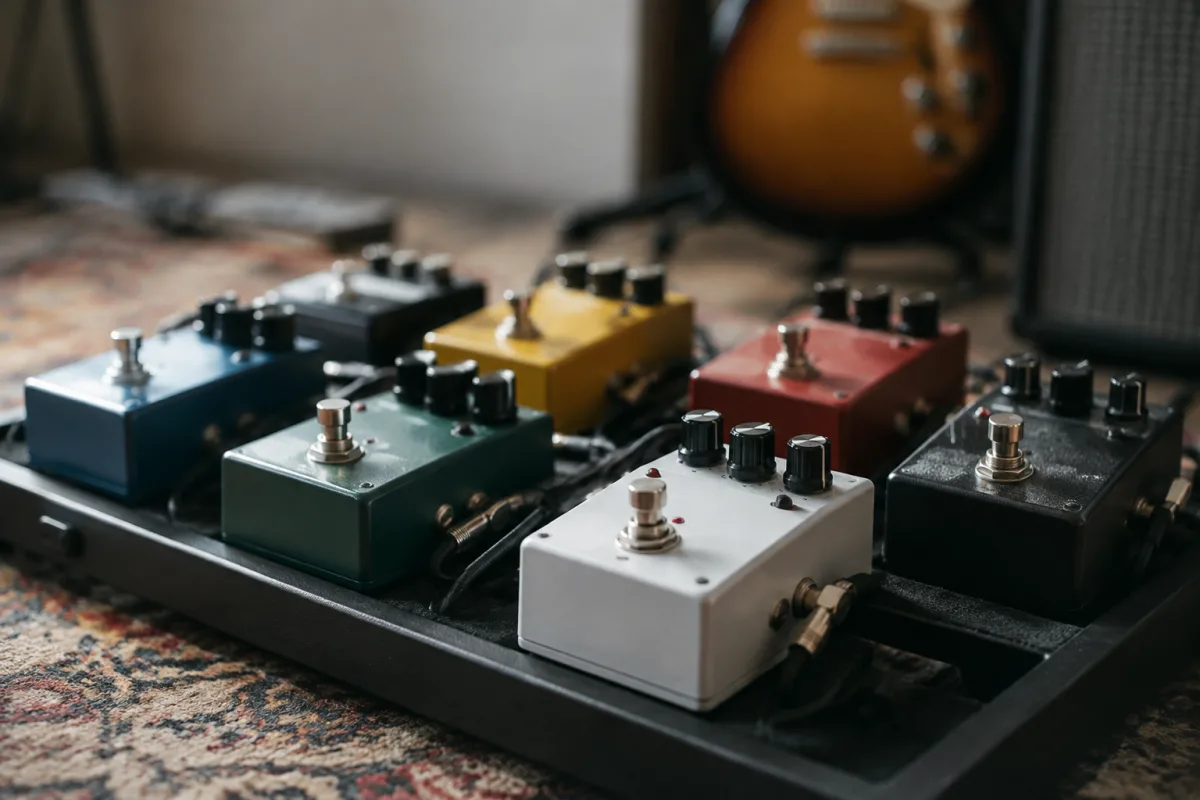
A boost pedal represents one of the most versatile additions to any guitarist's pedalboard. Whether you need additional volume for solos, pushing your amplifier into overdrive, or sculpting your tone character, a quality boost pedal transforms your playing possibilities. Understanding boost pedal types, specifications, and applications helps you select the right pedal matching your musical needs.
What Boost Pedals Do & Why They Matter
Boost pedals increase your signal level, providing additional output without altering tone significantly. A clean boost elevates volume for solos; a tone-shaping boost adds subtle harmonic colour; a treble booster emphasises high frequencies. This simplicity belies their power—boost pedals are among the most used effects in professional setups. Guitarists employ boosts to thicken rhythm tones, cut through dense mixes during leads, push tube amplifiers into saturation, and add sustain. Understanding your desired boost application guides pedal selection significantly.
Boost Pedal Types & Applications
| Boost Type | Sonic Effect | Best Use Cases |
|---|---|---|
| Clean Boost | Pure volume increase, minimal tone change | Lead solos, cutting through live mixes |
| Treble Booster | Emphasises high frequencies, adds brightness | Brightening muddy amps, texture enhancement |
| Overdrive Boost | Volume + light gain, harmonic colouration | Pushing clean amps, adding character |
| EQ Boost | Adjustable frequency sculpting | Compensating for amp/guitar limitations |
| Compressor Boost | Volume + dynamic control | Sustain enhancement, evening pick dynamics |
Key Specifications When Shopping
Gain amount measures boost intensity. Entry-level boosts offer 0-6dB; versatile models provide 0-12dB; extreme boosts exceed 20dB. Your amp determines realistic needs—tube amps push easily into overdrive with modest boost; solid-state amps require more. Tone controls allow shaping your boost character. A 3-band EQ (bass/mid/treble) offers flexibility; single tone knobs provide simplicity. Input/output impedance affects interaction with your signal chain—most quality boosts handle standard guitar impedance reliably.
Power Considerations & Portability
Most boosts use standard 9V power supplies; some accept 18V for increased headroom. Battery operation suits occasional gigging; power supplies serve active touring musicians. Footswitch size affects pedalboard real estate—compact boosts fit tight spaces; expanded versions include additional controls. Consider your pedalboard layout before purchasing. Weight remains negligible for boost pedals; size matters more.
Price Points & Value Proposition
Quality boosts range £50-£300. Entry-level boosts (£50-£100) deliver straightforward functionality perfectly suitable for most players. Mid-range options (£100-£200) offer additional tone-shaping and construction quality. Premium boosts (£200-£300) provide boutique craftsmanship and exceptional component quality. The law of diminishing returns applies—£150 boosts rival premium options for most playing situations. Begin at entry-level; upgrade if specific features call you.
Tone-Shaping Capabilities
Simple boosts offer only volume control—straightforward but limited for tone sculpting. Three-knob boosts typically include volume, tone, and sometimes level. More sophisticated boosts feature 3-band EQ, allowing distinct bass, mid, and treble adjustment. This flexibility suits players compensating for amp/guitar limitations or pursuing specific tonal aesthetics. Simplicity appeals to straightforward players; control freaks appreciate expandable options.
Common Boost Pedal Mistakes
First, purchasing extreme gain boosts when modest levels suffice—most applications use 6-12dB; going beyond wastes features. Second, underestimating tone interaction—a boost pushes your amp differently than another guitarist's rig; testing in your signal chain beats theoretical specifications. Third, neglecting input impedance compatibility—though rare, mismatches create tone loss. Fourth, overlooking pedalboard size constraints; compact boosts integrate better than oversized units. Fifth, assuming clean boosts sound identical—subtle differences in component quality yield noticeable tone variations.
Where Boosts Excel
Lead solos benefit enormously from clean boosts—volume increase cuts through band mixes without tone alteration. Rock and blues players frequently use boosts pushing tube amplifiers into natural overdrive. Players with solid-state or digital amps employ boosts compensating for limited natural breakup. Treble boosts suit players with dark, muddy amplifiers. Boost pedals integrate beautifully with overdrive and distortion chains—place boosts before gain effects to add sustain, after effects to push distortion. They're equally at home on simple boards and complex chains.
Integration with Signal Chains
Boost placement profoundly affects results. Early chain placement (after tuner) colours all subsequent effects. Mid-chain placement targets specific effect sections. After-distortion placement pushes already-distorted signals. Most players experiment extensively finding optimal placement. Start after tuner; adjust based on results. Quality boosts interface seamlessly regardless of placement; lower-end boosts occasionally exhibit noise or impedance issues affecting other pedals.
Build Quality & Reliability
Reputable boost manufacturers employ quality components—durable footswitches, reliable potentiometers, and robust enclosures. Entry-level boosts from unknown manufacturers occasionally suffer premature footswitch failure or scratchy controls. Mid-range and premium boosts rarely experience issues. Warranty support varies; established brands offer 2-3 year coverage; boutique makers provide lifetime warranty. Longevity matters—a £150 boost lasting 10+ years represents better value than £50 pedals requiring replacement every 2-3 years.
Onboard vs. External Controls
Compact boosts integrate all controls on the pedal itself—space-efficient but requiring knob-tweaking during performances. Larger boosts split controls between footswitch and knobs, allowing volume adjustment via foot while maintaining tone settings. Expression pedal integration suits advanced players modulating boost levels within songs. Beginners benefit from straightforward designs; advanced players appreciate expandable control options.
Testing Boosts Before Purchase
Try boosts through your specific amp and signal chain before purchasing. Tone preferences are deeply personal—what sounds brilliant through a Marshall might disappoint through a Fender. Boutique boosts often warrant mail-order risks due to return policies; mass-market boosts justify trying locally before committing. Online reviews provide useful guidance but can't substitute personal testing.
Popular Boost Pedal Recommendations by Category
Clean boosts excel in transparent tone enhancement. Treble boosters add distinctive brightness. Overdrive boosts blur lines between boosts and drive effects. EQ boosters offer flexibility for tone compensation. Boutique makers often produce superior tone-shaping boosts; established manufacturers deliver reliability at accessible pricing. Research specific models matching your budget and tonal intentions.
When Not to Use Boosts
Boosts aren't mandatory—many excellent players avoid them entirely. If your amplifier achieves desired overdrive naturally, additional boost becomes optional. Digital multi-effects units often include built-in boosts, eliminating need for dedicated pedals. Minimal-board players might prioritise other pedal types. Evaluate your specific needs rather than assuming boosts are essential.
Expansion & Long-Term Considerations
Your first boost likely won't be your last—many players accumulate multiple boosts serving different functions. A clean boost for volume, a treble booster for brightness, an overdrive boost for character. Quality boosts hold value reasonably well; reselling or trading upgrades remains viable. Select your initial boost addressing your most pressing need; expand as subsequent requirements emerge.
Conclusion & Final Guidance
Boost pedals represent smart investments enhancing tone and live performance flexibility. By understanding boost types, specifications, and applications, you'll select equipment addressing your specific needs. Quality matters—reliable boosts serve decades; budget alternatives disappoint. Start with entry-level clean boosts if uncertain; upgrade as your application clarifies. For comprehensive exploration of boost pedals and detailed comparisons, refer to our complete guide to boost pedals.
Conclusion
Whether you're enhancing solos, pushing tube amps, or sculpting tone, boost pedals deliver transformative results. Understanding your needs, researching options, and testing before purchase ensures satisfaction. Boost pedals represent wise additions to any pedalboard, serving your playing for years to come.



Comments