


Acoustic Guitar Effects article
Acoustic Guitar Effects for Beginners: A Complete Guide
Adding effects to an acoustic guitar doesn't mean losing its natural voice. This guide explores which effects work best for beginners and how to use them with restraint.
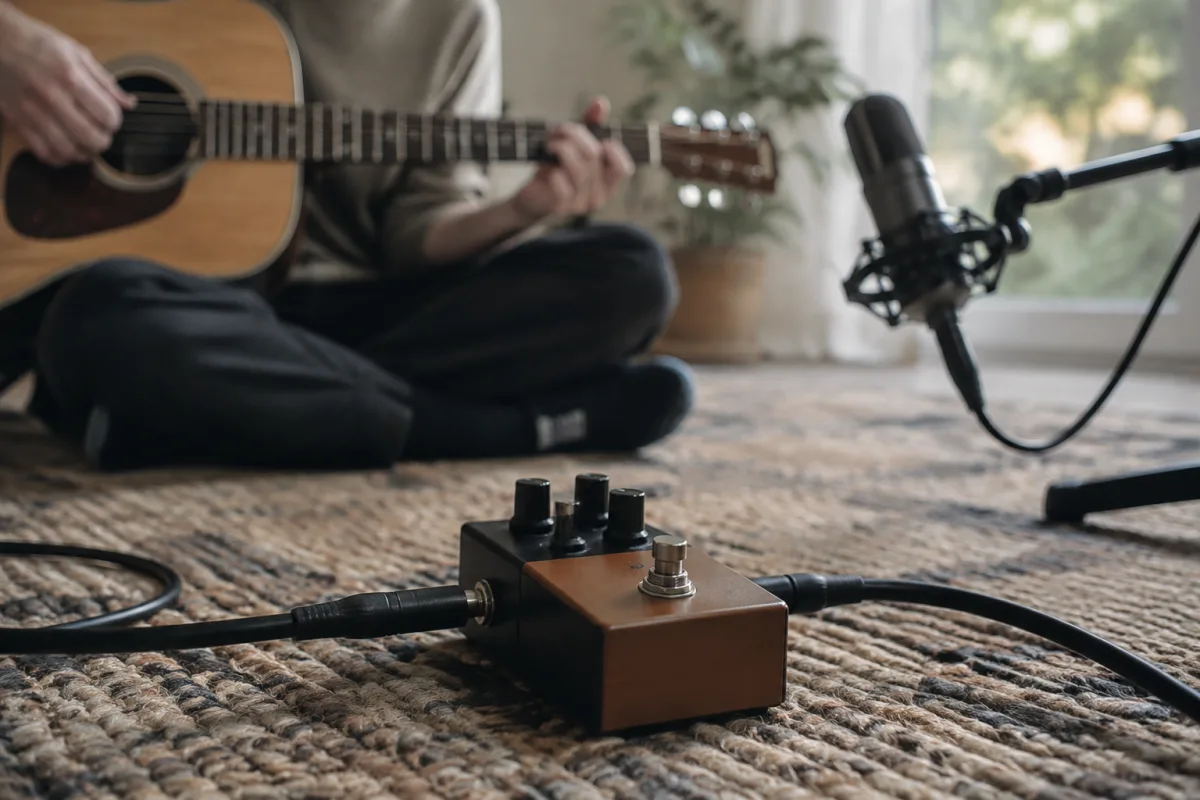
Adding effects to an acoustic guitar opens up new creative possibilities, but many beginners hesitate, worried that effects will hide the natural sound they love. The truth is simpler: acoustic guitar effects, when used thoughtfully, enhance rather than mask your instrument's voice. This beginner's guide walks you through which effects work best on acoustic guitar, how to use them subtly, and how to avoid the common mistake of turning your acoustic into an unrecognisable wash of sound.
Why Effects on Acoustic Guitar?
An acoustic guitar's biggest strength is its natural resonance and projection. You might think effects would only muddy that. In practice, the right effect used lightly can add depth, dimension, and character whilst keeping your acoustic guitar sounding like itself. A touch of reverb gives it room ambience. Subtle delay adds space. A gentle compression tightens the dynamic response. Used with restraint, effects enhance what the guitar already does well.
The key word is restraint. Electric guitarists often use effects heavily and obviously. Acoustic players use them differently — as a seasoning, not a sauce.
The Best Acoustic Guitar Effects for Beginners
There are hundreds of effects available, but most beginners will spend 90% of their time with just three. Master these, and you'll have enough to explore for years.
Reverb: The Foundation
Reverb simulates the natural reflections that happen when sound bounces around a room. On an acoustic guitar, reverb is the most natural-sounding effect. A small amount (not drowned in it) makes your guitar sound like it's in a larger space. Beginners gravitate toward reverb because it's almost impossible to use wrongly — even if you turn it up too much, it still sounds musical. A good starting point: 20–30% wet reverb, simulating a medium-sized room. Too much reverb (over 50%) makes you sound like you're playing in a cathedral; fun occasionally, but not a everyday sound.
Delay: Dimension
Delay repeats your notes after a short interval, creating depth and a sense of spaciousness. A delay set to a quarter-note (matching your song's tempo) sounds musical and in-time. Beginners often worry they'll overdose on delay, but used lightly (15–25% wet), it adds shimmer without muddiness. Start conservative: a 300–500 millisecond delay with just one or two repeats. You'll build up intuition quickly.
Compression: Clarity
Compression gently tames the dynamic range of your acoustic guitar, so quiet notes stay audible and loud notes don't overwhelm. For acoustic guitar, light compression (a ratio of 2:1 or 3:1) makes the instrument more consistent and easier to sit in a mix. It's less obviously musical than reverb or delay, but it's invaluable once you understand it. Beginners can start with their effect processor's "acoustic guitar" preset and hear what compression does, then adjust from there.
Effects You Might Avoid as a Beginner
Some effects sound fantastic on electric guitar but fight against an acoustic guitar's natural character. Save these for later:
- Distortion / Overdrive: These deliberately break up the sound. On an acoustic guitar, distortion usually sounds unnatural and thin, not musical. There are rare exceptions (fingerstyle fusion, avant-garde), but they're edge cases. Skip these for now.
- Modulation (chorus, flanger, phaser): These change the pitch and phase of your signal. They're fun on electric guitar but can make an acoustic guitar sound hollow. Beginners should avoid them until they're certain of their goal.
- Extreme effects (bit-crusher, heavy reverb, time-stretching): Save experimental territory for after your first year. Right now, focus on the three effects above.
How to Add Effects to Your Acoustic
There are three common ways to add acoustic guitar effects:
Acoustic Guitar Multi-Effects Unit
A compact device designed specifically for acoustic players. Brands like Zoom, Boss, and Korg make affordable acoustic effects units (£100–300) that include reverb, delay, compression, and other acoustic-friendly effects. These are ideal for beginners because they're tailored to the job and simple to operate. Plug your guitar in, adjust a couple of knobs, and play.
Individual Pedals
Many guitarists build a pedalboard with individual pedals. A beginner's acoustic setup might be: tuner → reverb pedal → delay pedal → output. This gives you control and flexibility, but requires more investment (£200+) and a bit more learning. Save this approach for after your first few months of effects exploration.
DAW / Recording Software Effects
If you're recording on a computer, your recording software (Ableton, Logic, Reaper, etc.) has built-in reverb, delay, and compression. Use these to learn what effects do, with zero additional cost. Many bedroom acoustic players start here.
First Session: A Practical Exercise
Here's how to explore acoustic guitar effects safely:
- Play something you know well — a chord progression, a fingerstyle piece, anything familiar.
- Start with reverb only. Dial in a small reverb (room size 20–30%) and listen for 2–3 minutes. Play melodies, chords, everything. Feel how reverb colours the sound.
- Add delay. Keep reverb at 20%, add a subtle delay (300ms, one repeat). Notice how they work together.
- Add compression. Set it to a light ratio (2:1) and hear how it steadies the tone.
- Play a song. Use all three. Pay attention to what sounds good and what feels too thick.
In your first session, you've now experienced the three core acoustic effects. Everything else you learn later is a variation or refinement.
Four Common Beginner Mistakes
Mistake 1: Using Too Much Reverb
Beginners often think "more is better" and turn reverb up to 80–100%, making the guitar sound distant and washy. Acoustic effects work best when they're subtle. If you're tempted to ask, "Is this too much?", it probably is. Cut it by half.
Mistake 2: Stacking Too Many Effects
A multi-effects unit lets you layer reverb *and* delay *and* chorus *and* tremolo all at once. The result is mud. Start with one effect. Add a second once you've mastered the first. Three effects is a full palette; leave it at that.
Mistake 3: Forgetting to Turn Effects Off
Sometimes the best moment in a song is a naked acoustic guitar with no effects. If your effects are always on, you lose that dynamic contrast. Learn how to toggle effects on and off using a footswitch. The interplay between dry and effected sound is essential to good effect use.
Mistake 4: Ignoring Tempo-Synced Delay
A delay that doesn't sync to your song's tempo sounds sloppy. Most acoustic effect units let you tap the tempo in (tap a footswitch in rhythm) or set the BPM manually. Do this. A delay that's locked to your song's pulse sounds professional instantly.
Getting the Sound You Want
Acoustic guitar effects are more about suggestion than statement. A reverb that suggests a larger room, a delay that suggests space, a compression that suggests control. The guitar's natural voice should always dominate. If you find yourself asking, "Is that still a guitar?", you've used too much effect. Pull back. The beauty of acoustic effects is in subtlety.
As your experience grows, you'll experiment with longer delays, different reverb types (plate, spring, hall), and how to layer effects creatively. But all of that builds on the foundation: light reverb, gentle delay, and just enough compression to keep things tight.
For a deeper exploration of acoustic guitar effects, effect types, and how to integrate them into your playing style, the complete guide to acoustic guitar effects covers the full landscape.


Comments