


Drum Hanger article
Drum Hangers and Tom Mounts: A Complete Guide
Hardware is the part of a drum kit nobody photographs — invisible in the finished sound, until it is not, at which point it is the only thing anyone can hear.
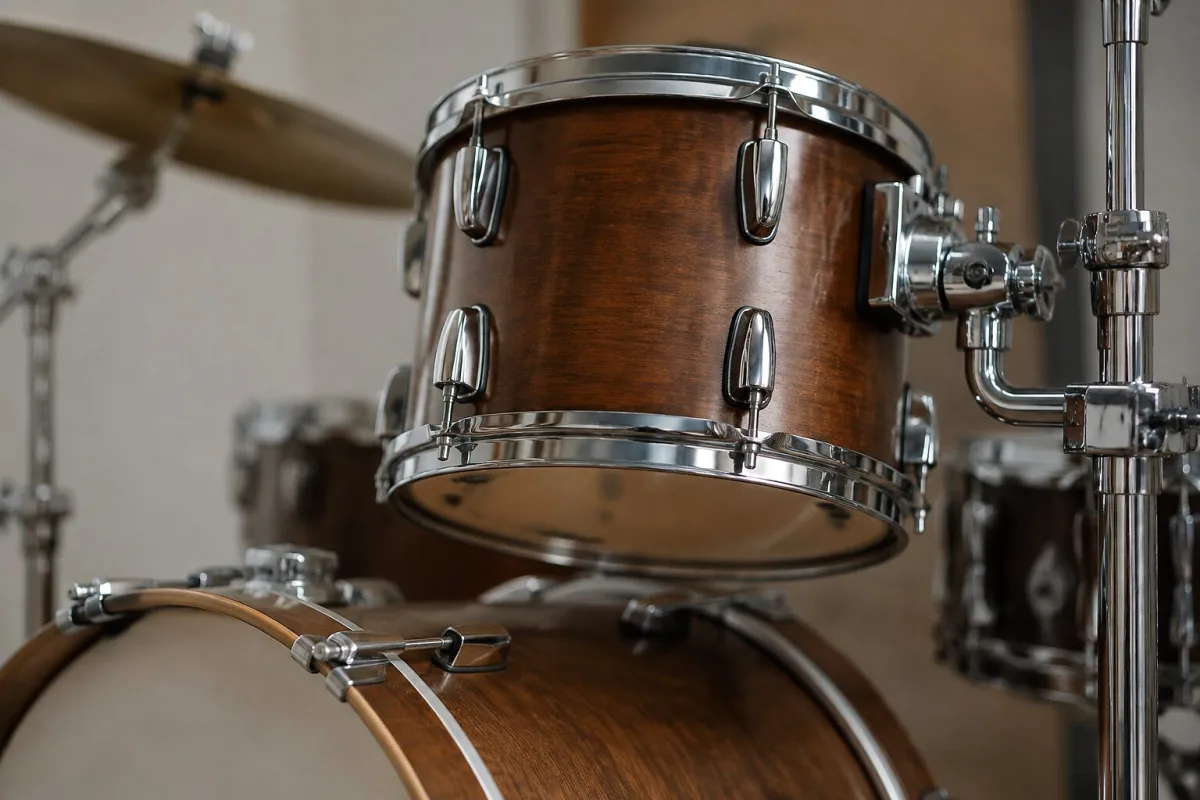
The drum hanger is part of the hardware nobody photographs. It holds everything up, costs a surprising amount, and is almost entirely invisible in the finished sound — until it is not, at which point it becomes the only thing anyone can hear.
How a tom is held is one of the few hardware decisions that genuinely changes the drum's voice, and it deserves rather more thought than it usually receives.
The problem a drum hanger solves
A drum resonates because its shell is free to vibrate. Anything clamped to that shell takes energy out of the system and shortens the note, in precisely the way a finger laid on a bell stops it ringing.
The traditional arrangement bolts a bracket directly to the tom's shell and hangs it from an arm on the bass drum. It is simple, strong and has held up under a great deal of loud music. It is also, unavoidably, a hand on the bell.
Suspension mounts
Thomas Gauger's RIMS design — Resonance Isolation Mounting System — answered this by removing the bracket from the shell altogether. The drum is held by its rim or hoop instead, so no metal touches the shell at all, and the tom is free to resonate as it was built to.
The effect is audible: more sustain, a fuller note, and a more open decay. It is the reason nearly every mid-range and professional kit now ships with some form of suspension mount rather than a shell-mounted bracket.
One point of clarity, since the terms drift: suspension is not the same claim as isolation. The mount reduces contact with the shell; it does not magically disconnect the drum from the room, and a poorly tuned tom on a suspension mount is still a poorly tuned tom.
When the older method is the right one
There is a genuine case for shell mounting, and it is not merely tradition or thrift.
The extra contact damps the shell slightly and shortens sustain. If a tom rings longer than the music wants — and in fast or dense playing it very often does — that damping is a feature rather than a fault. A shell mount is a small, permanent piece of tone control.
Shell-mounted brackets are also more rigid, which matters to players who hit hard and to anyone assembling a kit repeatedly in the dark.
Where the drum actually hangs from
Separate from the mount is the question of what holds it up, and this is more consequential than it looks.
- Bass-drum mounted. The tidiest arrangement and the fewest legs on the floor. It adds weight to the bass drum, makes it more awkward to carry, and limits where the toms can sit.
- Stand mounted. A separate stand carries the toms, leaving the bass drum untouched and free to resonate. More to carry, more floor taken, and far more freedom of position.
- Snare-basket mounted. Useful on large bass drums, where a bass-mounted tom can end up uncomfortably high. A basket keeps it where the arms actually are.
Players using a 24 or 26 inch bass drum commonly meet this problem, and the choice of drum hanger arrangement is usually what solves it.
Practical points worth knowing
- Memory locks earn their keep. Collars that mark each position let you rebuild the kit identically every time. They cost little and save a great deal of fiddling.
- Do not overtighten. Clamping a mount hard enough to bite deforms the hoop and chokes the drum. Firm is sufficient.
- Check compatibility before ordering. Post diameters and bracket patterns vary between manufacturers, and a drum hanger that does not fit your arm is an expensive paperweight.
- Protect the finish. Nylon or rubber inserts at contact points prevent the slow ring of wear that appears around every clamp eventually.
- Retrofitting is usually possible. Suspension mounts can often be added to a shell-mounted tom, though the original bracket holes remain unless filled.
What to look for when buying
The market runs from a few pounds to a surprising amount, and the differences are mostly in materials and tolerance rather than design.
- Casting quality. A cheaply cast drum hanger flexes under a hard hit, which shows up as a tom that creeps out of position over a set.
- Clamp geometry. Look at how the jaws meet the hoop. Even contact across a wide area holds better and marks less than a single hard point.
- Adjustment range. Ball-and-socket joints offer far more freedom than a ratcheting L-arm, which moves in fixed increments that never quite land where you want.
- Weight. Heavier is more rigid and also more to carry. Players who gig regularly tend to arrive at a different answer from players who never move the kit.
Buy once if you can. Hardware outlives drums, and a good mount will move from kit to kit for decades.
How much does it really matter?
Honestly: less than tuning, less than heads, less than the room, and very much less than the player. Anyone hoping a drum hanger will rescue a badly tuned kit will be disappointed.
But it is real, it is audible in a quiet room and on a close microphone, and it is one of the few upgrades that improves an instrument you already own rather than replacing it. On that basis it is usually money well spent — after the heads.





Comments