
Drum Pad Practice article
The Complete Guide to Drum Pad Practice
Drum pad practice is the foundation of solid drumming technique. Learn how to set up effective routines, master essential rudiments, and progress systematically to improve your full-kit playing.
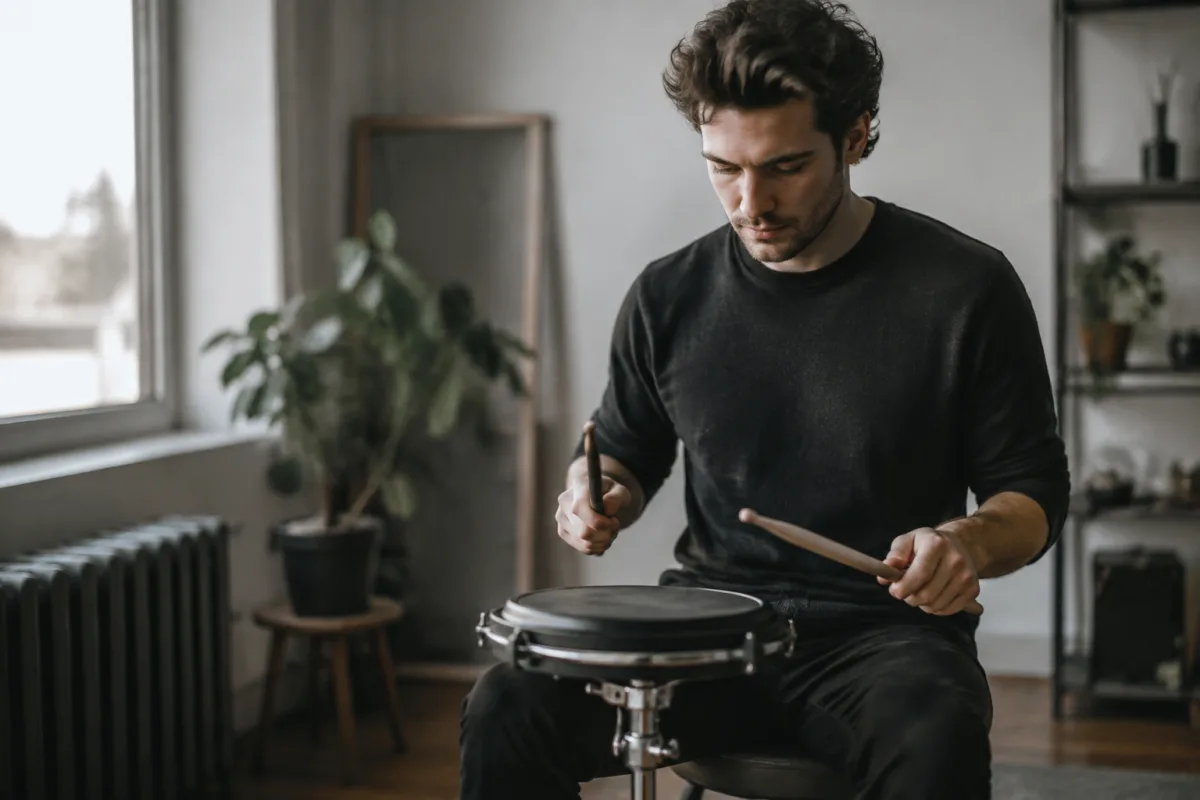
Drum pad practice is fundamental to developing fluent, controlled drumming technique. Whether you're a beginner learning rudiments or an experienced player refining your craft, a drum pad offers an ideal focused environment for building speed, accuracy and muscle memory without the volume of a full kit.
Why Drum Pad Practice Matters
A drum pad isolates the technical work—grip, stroke control, timing, and hand independence—from the complications of managing a full drum kit. You can concentrate entirely on refining your technique, working quietly in any setting, and practising for extended periods without disturbing others. Many professional drummers credit dedicated drum pad practice as essential to their development.
The feedback is immediate and honest: a sloppy stroke sounds sloppy, a clean one sounds clean. There's nowhere to hide, which makes the learning curve steeper but the progress more reliable. You're building genuine muscle memory, not just playing louder.
Setting Up Your Practice Space
A quality practice pad costs between £15 and £80 depending on size and features. Entry-level pads are adequate for learning basics, but investing in a pad with better response—such as Evans, Vic Firth, or Remo models—makes a noticeable difference. The playing surface should feel responsive and produce clear tone separation between strokes. Many drummers keep a pad at home, at work, or even in a gig bag for travel.
Position your pad at a comfortable height, roughly waist-height when standing naturally. Use proper drumsticks, not brushes or mallets—proper sticks develop the correct grip and muscle patterns for full-kit playing. Consider investing in a pad stand or clamping it to a table for stability.
Essential Rudiments for Drum Pad Practice
Start with the foundational rudiments that all drummers learn:
- Single strokes — alternating left and right at increasing tempos, building hand speed and evenness
- Double strokes — two strokes per hand, crucial for snare technique and quick note articulation
- Paradiddles — grouping strokes in specific patterns to develop complex hand co-ordination
- Flams — grace notes that add texture and dynamics to your playing
- Rolls — fast repeated strokes that form the basis of sustained sounds on drums
- Diddles — pairs of shorter strokes between main beats, used frequently in both rock and traditional styles
Master these fundamentals slowly and cleanly before attempting speed. Rushing into fast single strokes on a drum pad is counterproductive; you'll cement bad habits rather than good ones.
Effective Drum Pad Practice Routines
A focused routine beats random practice. Dedicate 20 to 60 minutes daily to structured work:
- Warm up — Start with single strokes at a slow, comfortable tempo (60 bpm). Play for two minutes to loosen your wrists and shoulders.
- Technique focus — Choose one rudiment or technique to work on. Practise it at three or four tempos: slow (80 bpm), moderate (120 bpm), fast (160+ bpm), then back down. Spend 8–10 minutes on this.
- Speed building — Once comfortable, gradually increase the tempo. Use a metronome and bump the tempo up by 5 bpm each time through, until you reach the limit of clean playing. Don't sacrifice accuracy for speed.
- Application — Play along with recordings in your chosen genre (rock, jazz, funk, etc.), applying the techniques in musical context. This bridges the gap between pad practice and actual playing.
- Cool down — Finish with a slow, even-paced set of strokes to relax your hands.
Hand Position and Grip
Correct grip is essential on a drum pad because you'll feel every mistake. Use a matched grip (both hands holding the sticks the same way) or traditional grip depending on the style you're learning. The grip should be relaxed but controlled—tension limits speed and causes injury.
Your fingers do most of the work; your wrists should be flexible and loose. A common beginner mistake is gripping too tightly, which causes fatigue and prevents the rebound that makes fast strokes possible. Record yourself or practise in front of a mirror to watch for tension in your shoulders and neck.
Tracking Progress on Drum Pad Practice
Keep a practice log. Note the date, the rudiments or techniques you worked on, the tempos you reached, and any breakthroughs or problem areas. A simple notebook works; some drummers use apps. Over weeks and months, you'll see clear improvement in your evenness, speed, and control. This tangible progress is motivating and helps you identify which areas need more work.
Set realistic milestones. Don't expect to play clean paradiddles at 200 bpm in a week. Steady, consistent practice—even 30 minutes daily—yields far better results than sporadic marathon sessions.
Choosing the Right Pad for You
There are several types of drum pads to consider:
| Pad Type | Best For | Price Range |
|---|---|---|
| Silent/practice pad | Quiet technique work, portable, general practice | £15–£50 |
| Mesh pad | More realistic feel, better for muscle memory, quieter than acoustic | £40–£150 |
| Electronic pad | Playing along with sounds, dynamics feedback, versatility | £60–£300+ |
| Acoustic practice pad | Natural rebound, short-term intensive practice | £20–£80 |
Most drummers start with a basic silent pad for learning rudiments. As you advance, upgrading to a mesh or electronic pad offers more realistic feel and feedback.
Common Mistakes in Drum Pad Practice
Avoid these traps:
- Practising too fast. Speed comes naturally from clean, slow repetition. Rushing accelerates only bad habits.
- Neglecting dynamics. A drum pad lets you work on soft, controlled strokes—vital for musicality and preventing injury. Don't just pound.
- Inconsistent practice. Three hours once a week is less effective than 30 minutes daily. Consistency builds muscle memory.
- Ignoring posture. Slouching or hunching causes tension and limits your range. Sit or stand with proper alignment.
- Skipping fundamentals. Too many drummers want to skip rudiments and go straight to playing songs. Don't—the foundations matter.
Integrating Pad Practice Into Your Playing
The goal of drum pad practice is not to become a pad virtuoso—it's to improve your full-kit playing. Once you've developed a technique on the pad, apply it. Play those paradiddles in a rock beat. Use your newly developed double-stroke control to execute a snare roll in a jazz setting. The pad is a laboratory; the kit is where the technique lives musically.
Top drummers use the pad not as a replacement for kit practice but as a complement. A typical week might include pad work on specific rudiments three or four days, full-kit practice two or three days, and playing along with music or in ensembles once or twice weekly. That balance drives real improvement.
Conclusion
Drum pad practice is the most efficient, accessible way to develop technique, build speed and accuracy, and create solid muscle memory. It requires no soundproofing, minimal space, and no financial outlay beyond a modest pad and a pair of sticks. Whether you're learning your first rudiments or perfecting advanced techniques, consistent, focused drum pad practice will improve your overall drumming more directly than anything else you can do. Start with the fundamentals, maintain proper form, and progress at a sustainable pace—and you'll find your full-kit playing transforms accordingly.


Comments